
Caramelized onion Gruyere puff pastry tartlets turn a sheet of pastry and a skillet of slowly cooked onions into small Thanksgiving appetizers. The onions provide sweetness and savory depth, Gruyere melts over the center, and a clear pastry border rises around the filling. The most useful preparation decision is to cook and cool the onions before working with the pastry.
This proposed recipe makes twelve small squares from one sheet of puff pastry. Allow roughly ninety to one hundred five minutes overall, including onion cooking, cooling, assembly, and baking, with some stages overlapping. It is an original recipe draft rather than a kitchen-tested formula. Puff pastry brands and onion moisture vary, so package directions and visual cues matter.
These are modest appetizer bites, not full individual tarts. Their appeal comes from a small amount of rich filling on a crisp base. Overloading the centers or adding warm onions to soft pastry makes them harder to bake evenly, so restraint is useful throughout the method.

Why these tartlets fit Thanksgiving appetizers
The onions can be prepared ahead, which moves the longest active stage away from guest arrival. On serving day, cold pastry is cut into squares, topped, and baked. This gives you a warm appetizer without having to caramelize onions while also managing the main meal.
Gruyere provides a nutty savory flavor that pairs naturally with onions and thyme. A teaspoon of balsamic vinegar in the onions adds a little acidity rather than turning the filling into a sweet jam. The result works beside a lighter vegetable appetizer or a small dip instead of requiring another elaborate starter.
The pastry still needs oven space at 400°F. Plan that interval rather than assuming an appetizer can fit at any temperature beside the turkey. If the oven schedule is crowded, bake the tartlets before the main cooking stage and reheat appropriately, accepting that freshly baked pastry usually has the strongest texture.
Choose onions and slice them consistently
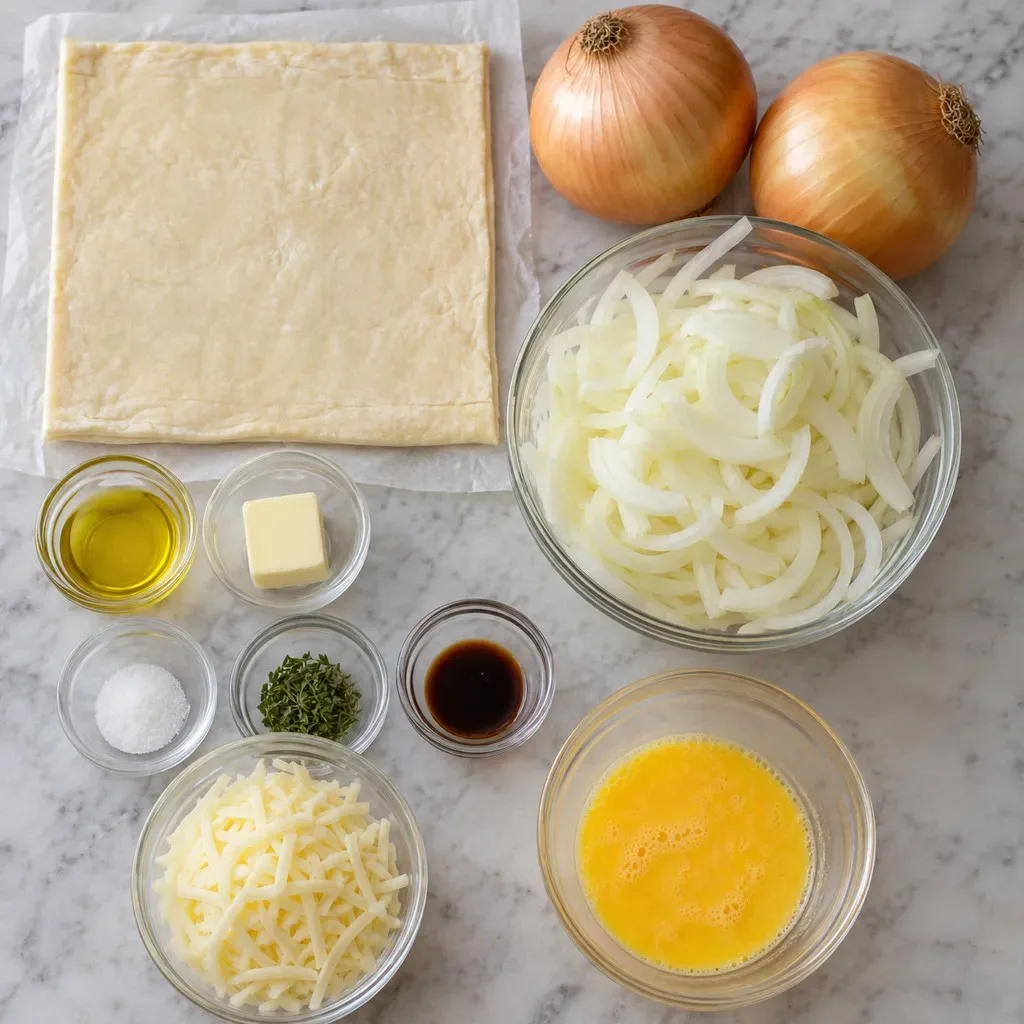
Yellow onions are a practical choice for this filling. Use two large onions, about one and a quarter pounds in total, and slice them thinly. Similar thickness helps the pieces soften together. Large thick chunks can remain firm while the smallest edges darken, making the final mixture harder to spread neatly on small pastry squares.
Peel, halve through the root area, and slice with a stable cutting surface. Discard the tough root end and dry outer layers. There is no need to achieve paper-thin shavings, but aim for slices that will collapse into soft strands during the slow skillet stage.
Sweet, white, or red onions can be used as variations, with different flavors and colors. Do not assume that any onion will caramelize in an exact number of minutes. Water content, pan width, heat, and batch size all affect the progression. Use the deeply golden appearance and soft texture as the main signals.
Caramelize patiently rather than scorching
Heat the tablespoon each of olive oil and butter in a wide skillet over medium-low heat. Add onions and salt, then stir to coat. As the onions soften, they release moisture and reduce in volume. Stir periodically, increasing attention as the pan becomes drier and the onions begin to color.
The proposed thirty-five-to-forty-five-minute range is an estimate. A smaller pan or wetter onions can take longer. If the bottom develops browned residue that is beginning to stick, add a small splash of water and scrape gently. This loosens flavorful browned material without requiring the onions to fry in an ever-larger amount of fat.
Do not raise the heat sharply simply because dinner is approaching. Dark edges on otherwise firm onions indicate scorching rather than an evenly developed filling. Lower the heat and give the mixture time. The onions should become soft strands with a rich golden color, not a mixture of black tips and raw centers.
Finish and cool the onion filling
Stir in thyme leaves and balsamic vinegar near the end. Cook briefly so the vinegar distributes through the onions, then remove from the heat. The filling should be moist but not surrounded by a pool of liquid. If necessary, cook away a little excess moisture before beginning the cooling stage.
Transfer the onions to a shallow heat-safe container so they cool more readily than in a deep hot pan. They must be completely cool before being placed on the pastry. Warm filling melts the fat in puff pastry and can make the dough sticky before the oven has a chance to create its layers.
For advance preparation, cool promptly and refrigerate covered. Do not leave cooked onions sitting out all afternoon because they contain no meat. The filling can be made a day ahead for a straightforward holiday schedule. Keep it cold until assembly, and count advance preparation when planning leftover storage.
Handle puff pastry while it is cold
Thaw the pastry according to its package directions. Some sheets are folded, and forcing an icy fold open can crack the dough. At the other extreme, very warm pastry becomes soft and difficult to cut cleanly. The useful working state is pliable enough to unfold while still noticeably cool.
On a lightly floured surface, roll the sheet toward a nine-by-twelve-inch rectangle and cut twelve three-inch squares. Package sizes vary, so adjust gently without stretching a small sheet excessively thin. Keep the squares relatively even so they puff and color at a similar pace.
If the dough becomes sticky or floppy, pause and chill it rather than continuing to add flour. Excess flour can make the surface dusty and dry, while warm fat damages the layered structure. Work in manageable stages and have the baking sheet and filling ready before taking the pastry out.
Score borders and keep the filling central
Place squares on a parchment-lined sheet pan with some space between them. Score a quarter-inch border inside each square without cutting all the way through. Prick the centers lightly with a fork. The border is meant to rise around the filling while the center remains relatively flatter.
Brush the borders lightly with egg wash. Avoid flooding the cut sides, where pooled egg can interfere with the layers separating neatly. Divide the cooled onions across the centers, then add Gruyere. Leave the scored edge visible rather than spreading filling from corner to corner.
A small even mound is more useful than a large wet heap. If there is more onion filling than the pastry can hold comfortably, reserve some for another use rather than forcing it onto the squares. Excess weight and moisture make the bases slower to bake and can spill over the edges.
Bake for color on the base as well as the top
Heat the oven to 400°F, or 200°C, and bake for approximately eighteen to twenty-two minutes. Look for well-risen golden borders and a base that is cooked rather than pale and flexible. Lift a tartlet carefully with a spatula to inspect the underside instead of judging only the cheese on top.
Puff pastry benefits from a properly heated oven. A tray placed into an oven still warming up may soften before it puffs effectively. Follow the pastry package guidance where it differs in a material way, and use the appearance of the dough to adjust timing. Brand, thickness, and oven behavior all matter.
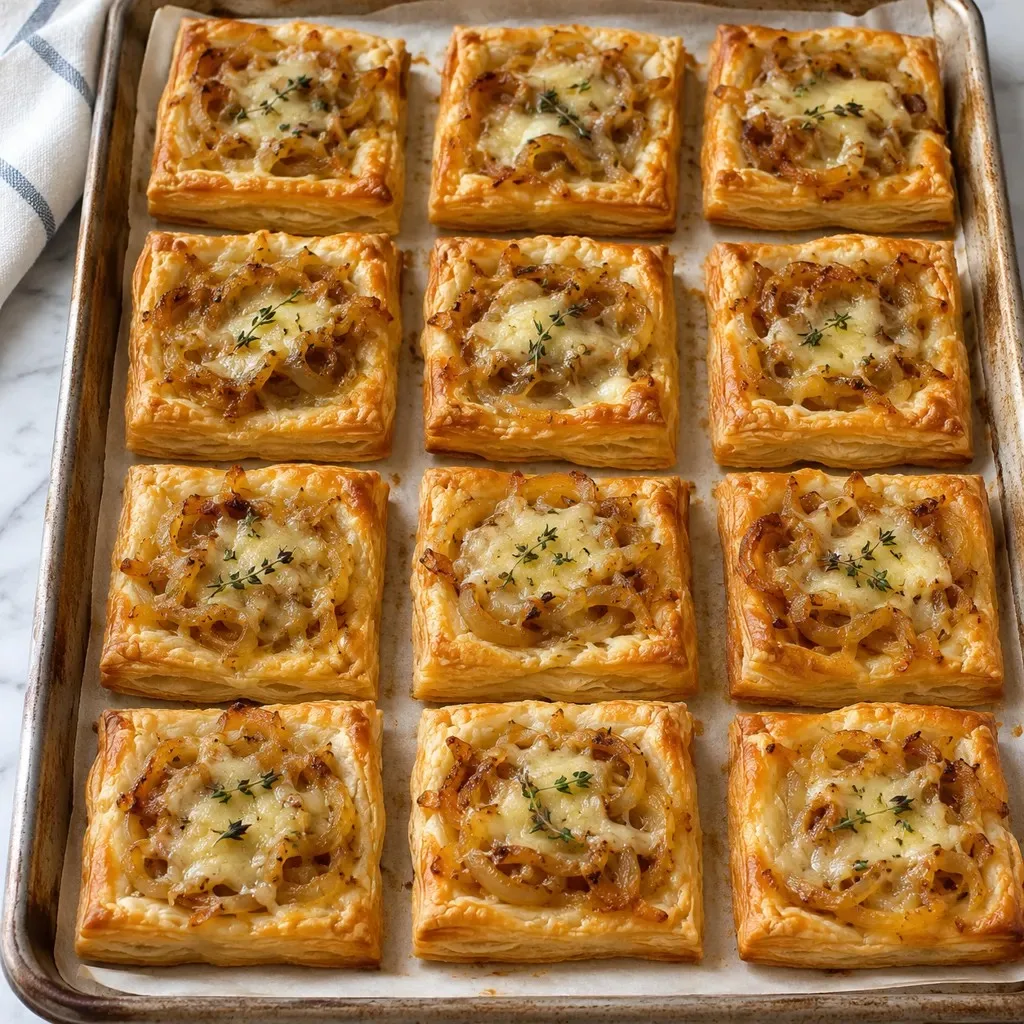
Let the tartlets cool for about five minutes before serving. The filling can be much hotter than the outer crust suggests. Move them to a platter without stacking while hot, because steam trapped between layers softens the bases. They should be easy to pick up once comfortable to handle.
Make-ahead choices and holiday timing
The strongest make-ahead step is caramelizing the onions. You can also grate the cheese and set out the tray, parchment, and cutting tools in advance. Keep perishable ingredients refrigerated. This turns the final preparation into a short assembly task rather than a full cooking project.
For short advance assembly, keep the tartlets chilled and bake while the pastry remains cold. Do not leave raw pastry squares with moist filling on the counter while the oven is occupied. The longer the filled pastry waits, the more likely the center is to soften, so use a modest refrigerator interval rather than promising an unlimited make-ahead hold.
Baked tartlets can be cooled promptly and refrigerated for reheating. Reheat cooked leftovers to 165°F in the center, using an oven to preserve more crispness than a microwave usually provides. Exact time depends on size and starting temperature. Do not reheat solely until the cheese bubbles at the edge and assume the middle is hot.
Cheese substitutions and dietary notes
Swiss-style cheese, Comte, or Fontina can provide a useful melting variation. Sharp cheddar gives a different flavor and may release oil differently. Keep the quantity moderate and choose a cheese that melts rather than a very dry product that stays in hard fragments across the onions.
Puff pastry ingredients vary. Some products contain butter, others use different fats, and allergen statements differ. The standard recipe contains wheat, dairy, and egg. An egg-free border can be a separate variation, but removing the egg wash does not make a butter pastry and cheese filling dairy-free.
For vegetarian guests who avoid animal rennet, select a suitable cheese. Check the pastry and all other labels for the requirements involved. Major changes such as gluten-free pastry or dairy-free cheese need their own timing and texture expectations rather than a promise that the original photograph will be reproduced exactly.
Troubleshooting pastry and filling
Soggy bases often result from warm filling, excess onion liquid, too much topping, or pastry that was already soft before baking. Address those points first. Raising the heat dramatically can burn the borders before the center dries. Use a properly heated oven and an appropriately thin, restrained filling layer.
Borders that do not rise may have been cut through completely, covered with filling, or soaked in egg wash. Very thin rolled pastry also has less structure to lift. Keep the score shallow and leave the edges clear. If the pastry is warm, chill before baking rather than expecting the oven to repair it.
Bitter onions usually indicate scorching. Additional balsamic vinegar or cheese cannot remove burnt flavors. If the filling tastes sharply acidic, the vinegar may not have been distributed or the amount was increased substantially. Keep the first batch close to the measured formula, then make small deliberate changes in later versions.
Serving, scaling, and leftovers
Offer the twelve tartlets as part of a mixed appetizer table. If feeding twelve people and this is the only appetizer, one small square each may be insufficient; scale according to the rest of the menu. For a larger batch, use additional pastry sheets and trays rather than making every square heavily loaded.
Refrigerate perishable leftovers within two hours, reduced to one hour above 90°F. Store at 40°F or below and use within three to four days, counting the earlier preparation of the onion filling. Keep a record of when the filling was cooked so reheating does not appear to restart the storage clock.
Avoid stacking warm tartlets in a sealed container because condensation softens the pastry. For reheating, spread them in one layer and check the filling reaches 165°F. They may not be quite as crisp as a fresh bake, but careful oven reheating is more predictable than repeatedly microwaving a large pile.
Frequently asked questions
Can I caramelize the onions the day before?
Yes. Cook them fully, cool promptly in a shallow container, and refrigerate covered. Use cold filling on cold pastry during assembly. This is the most useful advance task because it removes the longest cooking stage from the final appetizer preparation.
How do I keep puff pastry tartlets crisp?
Keep the dough cold, use completely cooled onions, avoid excess liquid, and leave the borders clear. Bake until the bases are cooked as well as the tops. Do not stack or tightly cover the tartlets while they are still steaming.
What can I use instead of Gruyere?
Swiss-style cheese, Comte, or Fontina can work as flavor variations. Sharp cheddar is another option with a different character. Use a moderate amount and expect melting behavior to vary. Choose suitable enzymes if serving vegetarians who avoid animal rennet.
Can I assemble the tartlets ahead?
You can assemble for a short refrigerated interval, but do not leave filled pastry at room temperature while waiting for oven space. For the most controlled result, prepare onions and cheese ahead and assemble near baking. Warm or wet filling makes advance assembly less dependable.
Caramelized Onion Gruyere Puff Pastry Tartlets
By Amanda · Original proposed recipe
Ingredients
Instructions
- Heat oil and butter in a wide skillet over medium-low heat. Add onions and salt. Cook 35–45 minutes, stirring and adding a small splash of water if sticking, until deeply golden. Stir in thyme and vinegar. Cool completely.
- Heat oven to 400°F (200°C). On a lightly floured surface, roll cold puff pastry to roughly 9 by 12 inches and cut into twelve 3-inch squares.
- Place on a parchment-lined sheet pan. Score a 1/4-inch border on each square without cutting through. Prick centers, brush borders lightly with egg wash, and divide cooled onions and Gruyere among centers, leaving edges clear.
- Bake 18–22 minutes, until pastry is well puffed and golden on the base as well as edges. Cool 5 minutes before serving. Allow about 90–105 minutes including cooling and overlap.
Original proposed recipe; not kitchen-tested. All times are estimates. Scaling changes ingredients only; cooking time, temperature, pan space, and doneness still need attention. Yield is 12 tartlets. Total includes onion cooling and a short rest, with some work overlapping.
Food safety references
FoodSafety.gov: safe cooking and reheating temperatures; FDA: egg safety.