
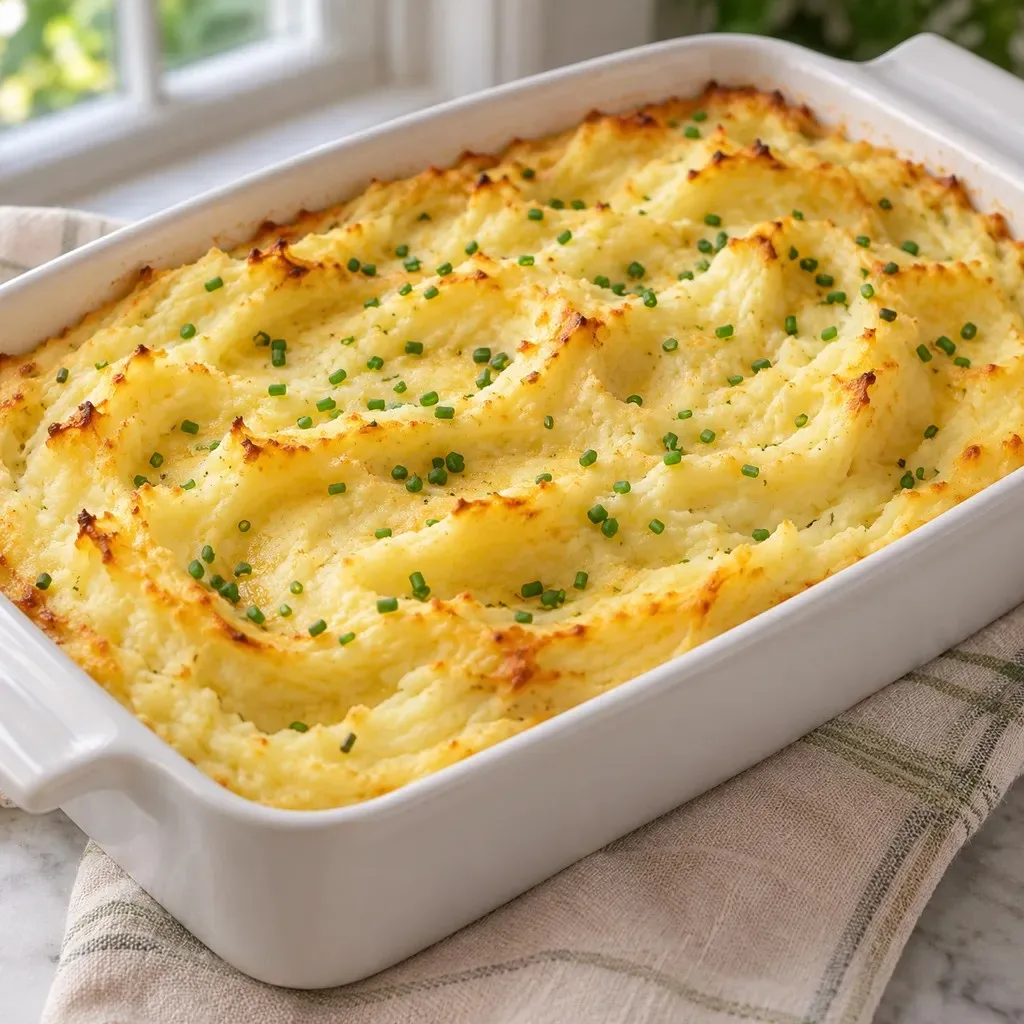
Make-ahead mashed potato casserole turns a familiar Thanksgiving side into a dish you can organize before the last-minute rush. Yukon Gold potatoes are mashed with butter, cream cheese, and warm milk, spread into a baking dish, and finished with buttery ridges and chopped chives. The method focuses on gentle handling so the potatoes remain fluffy rather than gluey.
This proposed recipe serves ten as a side in a nine-by-thirteen-inch dish. Plan about twenty-five minutes of preparation and roughly fifty-five minutes of cooking across the pot and oven stages, with timing varying according to the size of the potato chunks and whether the casserole starts warm or chilled. It is an original recipe draft, not a kitchen-tested claim.
The make-ahead advantage comes from doing the peeling, cooking, and mashing earlier, then reheating safely before dinner. A chilled casserole will not follow exactly the same schedule as fresh warm mash. Use a thermometer for reheating and choose a dish that can safely tolerate the temperature changes involved.
Why cream cheese helps this holiday side
Cream cheese adds tang and richness to mashed potatoes without needing a separate sauce. It makes the dish feel substantial, which is useful when portions share the plate with turkey and vegetables. Butter and milk still matter: the cream cheese is part of the mixture rather than a replacement for every other source of moisture.
Chives contribute a mild onion flavor and green flecks without the moisture of a large raw onion. Most go into the mash, while a small reserved amount finishes the baked top. That separation keeps the garnish fresh and makes the savory flavor clear without hiding the potatoes beneath cheese or breadcrumbs.
The casserole also gives you a defined serving dish before guests arrive. Instead of mashing in a crowded kitchen at the last moment, you can plan the reheating interval and concentrate on the main meal. This works best when the dish depth, refrigerator space, and oven schedule are considered in advance.
Choose potatoes and cut them evenly
Yukon Gold potatoes produce a creamy texture and a naturally golden color. Choose firm potatoes without extensive damage or green areas. Peel and cut them into chunks around one and a half inches across. Uniform pieces are more important than making every shape perfect because thick chunks lag behind small pieces during simmering.
Put the potatoes into a pot and cover with cold water rather than dropping large raw chunks directly into boiling water. Bring to a boil, then reduce to a steady simmer. A violent boil can break the outside while the centers remain firm. Salt the cooking water according to your preference, remembering that the mash will receive measured salt later.
Start checking after about fifteen minutes of simmering. A thin knife should enter a central piece easily without meeting a hard core. Do not remove them solely because the edges look soft. Undercooked potato pieces do not become smooth just because they are mashed more aggressively.
Drain and let excess steam escape
Drain the cooked potatoes carefully, then return them to the warm pot for a minute or two. The residual heat helps surface moisture evaporate. Shake or stir gently so the bottom does not scorch. You want dry-looking surfaces, not potatoes left unattended over strong heat until they stick.
Water carried into the mash dilutes the dairy and can make the casserole loose. Trying to repair that later with large quantities of cheese changes both flavor and structure. A brief drying stage is a more controlled way to begin than adding ingredients to a wet pot and hoping the oven removes the excess.
Keep the potatoes warm while mashing. Cold cooked potatoes are harder to work gently and can encourage overmixing. Arrange the butter, cream cheese, and warm milk before draining so the next stage follows smoothly rather than leaving the pot waiting while you search through the refrigerator.

Mash gently and add dairy in stages
Use a potato masher or ricer. A ricer gives a relatively even texture, while a hand masher can leave a few pleasant small pieces. Avoid a blender or food processor; their aggressive action can release too much starch and make the mixture sticky. More mixing does not necessarily mean smoother, better potatoes.
Fold in four tablespoons of butter and the softened cream cheese. Add the warm milk gradually, using the listed quantity as the starting point. The mixture should be soft enough to spread without flowing like a sauce. Potato moisture varies, so a little additional milk may be helpful, but add it in small measured amounts.
Stir in the measured salt, pepper, and two tablespoons of chives. Taste before deciding on more salt because the cooking water and dairy products contribute their own amounts. Avoid beating vigorously after every addition. The aim is to distribute ingredients with as little unnecessary agitation as practical.
Assemble a casserole that reheats evenly
Spread the mash into a greased nine-by-thirteen-inch baking dish. A broad shallow layer warms more predictably than a deep mound in a small bowl. Use the back of a spoon to create a few ridges, which provide places for light browning. Do not compress the potatoes into a tightly packed slab.
Dot the surface with the remaining two tablespoons of butter. The base recipe does not need an additional cheese topping. The butter adds flavor to the ridges while the interior stays creamy. Reserve the final tablespoon of chives for after heating rather than baking every bit of green garnish into the surface.
If baking immediately, use a 375°F, or 190°C, oven and allow roughly twenty-five to thirty-five minutes for the warm mixture to become hot and lightly golden. Dish material, depth, and how long the mash cooled during assembly change the exact time. Check the center rather than judging only the browned edge.
Cool safely when making the potatoes ahead
For advance preparation, cool the mash promptly in shallow containers and refrigerate within the safe holding limit. Do not leave a deep hot casserole on the counter until every part reaches room temperature. Smaller shallow portions allow more efficient cooling and make refrigerator storage easier to organize.
Keep the refrigerator at 40°F or below. Use covered containers once the food is appropriately stored, and label the preparation date so it remains clear during a busy holiday week. If the potatoes were made a day ahead, that day counts toward the total refrigerated storage period rather than disappearing when the casserole is reheated.
Transfer chilled potatoes to a suitable oven-safe dish for reheating if the storage vessel is not appropriate. Follow the manufacturer's directions for glass or ceramic, especially regarding rapid temperature changes. Do not assume every refrigerator-cold dish can safely enter a hot oven simply because it was sold as bakeware.
Reheat the chilled casserole without drying it out
Cover the casserole for most of the reheating stage so moisture does not escape too quickly. At 375°F, a chilled shallow dish may need about forty to fifty-five minutes or longer, but the center temperature determines readiness. Reheated leftovers should reach 165°F. Check several central spots rather than measuring only near the hot dish wall.
Uncover near the end if you want the surface to regain some color. If the potatoes look dry before the center is hot, add a small amount of milk carefully rather than pouring in enough to make a liquid layer. Avoid stirring the whole casserole repeatedly, which can damage the fluffy texture and erase the surface ridges.

Add the reserved chives after heating. Let the dish settle briefly before serving, using a broad spoon to lift portions. A warm serving dish can hold heat, so place it on a suitable trivet and warn guests if the handles are hot. The resting pause is for serving comfort, not a substitute for proper reheating.
Fit the potatoes around the Thanksgiving menu
These potatoes use a moderate oven, which may fit alongside some casseroles but not every roasted vegetable. Write down the required temperature and whether the dish starts warm or chilled. A recipe that fits in thirty minutes from warm mash can take substantially longer from the refrigerator.
If the turkey occupies the oven until close to dinner, consider a smaller reheating portion or another appropriate method rather than relying on an impossible schedule. Do not crowd the oven so tightly that air cannot circulate. Check each dish independently when several foods share the space.
For a larger gathering, prepare two similar shallow dishes instead of one very deep casserole. Doubling ingredients does not mean doubling every cooking time. Two dishes also allow you to serve one while keeping another portion safely stored or held according to a proper temperature-control plan.
Ingredient swaps and what they change
Russet potatoes can be used for a different, often fluffier style, but they may absorb dairy differently. Add milk gradually and judge the consistency. Leaving all skins on creates a rustic texture and changes the presentation; wash thoroughly and decide whether that style suits the rest of the meal.
Sour cream is not an exact equal replacement for cream cheese because it has a different consistency and moisture level. If substituting, reduce other liquid cautiously and treat the result as a variation. A dairy-free version needs alternatives for butter, milk, and cream cheese, each of which affects flavor and texture.
For a different herb profile, a small amount of parsley can replace some chives. Strong raw garlic is not an automatic improvement and can dominate a large dish of potatoes. If you want garlic flavor, use a separate developed variation with properly prepared garlic rather than adding several raw cloves to the finished mash.
Troubleshooting gluey, watery, or lumpy potatoes
Gluey potatoes usually reflect overworking, especially with high-speed blades. They cannot reliably be returned to a fluffy state by adding more milk. Use a gentle tool next time and stop once the ingredients are combined. Serving the current batch as a denser side is more realistic than continuing to beat it.
Watery potatoes may come from insufficient draining or excessive milk. Add liquid gradually in future batches and let steam escape after boiling. If the mash has a few firm lumps, the potatoes may have been undercooked. Mashing harder is not a substitute for checking tenderness before draining.
A dry top with a cool middle suggests the reheating dish was uncovered too long or the layer was too deep. Cover, continue heating, and check temperature. An attractive surface is not proof that the center is ready, particularly when the casserole started cold.
Storage, freezing, and leftover portions
Refrigerate leftovers within two hours, or within one hour above 90°F, and use within three to four days of the original preparation. Keep at 40°F or below and reheat to 165°F. Divide into manageable portions rather than repeatedly warming and cooling the entire holiday dish.
Mashed potatoes can be frozen, but dairy and potatoes may change texture after thawing. Freeze cooled portions in suitable containers and thaw in the refrigerator before reheating. A small amount of milk folded in during warming can help a dry portion, but it cannot guarantee an identical fresh texture. For the main Thanksgiving meal, a nearby refrigerated make-ahead day is the more predictable plan.
Frequently asked questions
How far ahead can I make mashed potato casserole?
Preparing it a day ahead is a practical starting point. Cool promptly, refrigerate safely, and count that day toward the overall three-to-four-day leftover window. Reheat to 165°F and allow more time for a chilled dish than for freshly assembled warm mash.
Why do mashed potatoes turn gluey?
Aggressive blending or prolonged beating can release too much starch. Use a ricer or hand masher and fold in dairy gently. Make sure the potatoes are fully tender before draining so you do not try to solve hard centers with excessive mixing.
How do I reheat without drying the potatoes out?
Use a shallow dish, cover for most of reheating, and check the center temperature. Add only a small amount of milk if needed. Uncover briefly at the end for color, then add fresh chives. Reheating should warm the interior safely rather than simply brown the top.
Can I freeze the casserole?
Yes, with possible texture changes. Freeze cooled portions, thaw in the refrigerator, and reheat to 165°F. Expect the mash to need a little adjustment after thawing. A small refrigerated batch made close to the holiday is more predictable if presentation and texture are priorities.
Make-Ahead Mashed Potato Casserole with Cream Cheese
By Amanda · Original proposed recipe
Ingredients
Instructions
- Put potatoes in a pot, cover with cold salted water, and bring to a boil. Simmer 15–20 minutes after boiling until easily pierced; drain and return to warm pot 1–2 minutes to evaporate excess moisture.
- Mash or rice potatoes. Fold in 4 tablespoons butter, cream cheese, warm milk, measured salt, pepper, and 2 tablespoons chives. Do not use a blender.
- Spread in a greased 9-by-13-inch baking dish and dot with remaining 2 tablespoons butter. Bake fresh at 375°F (190°C) for 25–35 minutes until hot and lightly golden.
- For making ahead, cool in shallow containers and refrigerate promptly; transfer to an oven-safe dish suitable for temperature changes when reheating. Reheat covered at 375°F (190°C) until center reaches 165°F (74°C), then uncover to color. Chilled portions may need 40–55 minutes or longer. Garnish with remaining chives.
Original proposed recipe; not kitchen-tested. All times are estimates. Scaling changes ingredients only; cooking time, temperature, pan space, and doneness still need attention. Chilled casserole takes longer to reheat. Reheat to 165°F (74°C); use bakeware suitable for temperature changes.
Food safety references
FoodSafety.gov: safe cooking and reheating temperatures; FDA: egg safety.